Applications of THz detection techniques in accelerator and free electron laser science
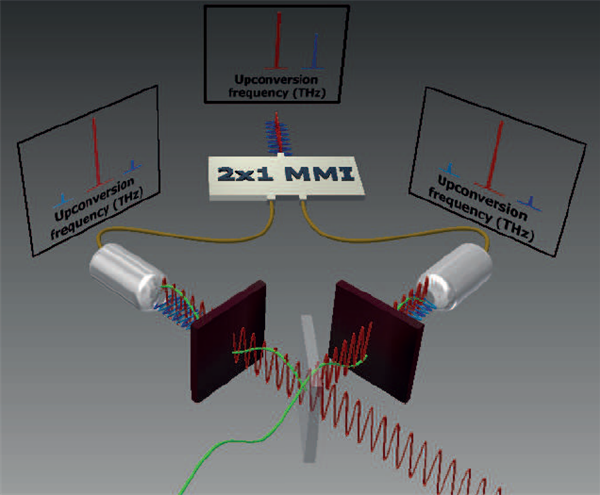
NEW: Wireless high-speed data communication using terahertz (THz) carrier frequencies is becoming reality with data rates beyond 100 Gbit s–1. Many of the mobile applications use internet access and require that THz wireless base stations are connected to a global network, such as the radio-over-fibre network. We present the realization of an ultrawide bandwidth THz optical single-sideband (OSSB) modulator for converting (free-space) THz signals to THz optical modulations with an increased spectral efficiency. THz OSSB will mitigate chromatic dispersion-induced propagation losses in optical fibres and support digital modulation schemes. We demonstrate THz OSSB for free-space radiation between 0.3 and 1.0 THz using a specially designed dichroic beamsplitter for signal and carrier, and a planar light-wave circuit with multimode interference structures. This arrangement of optical elements mimics the Hartley single-sideband modulator for electronics signals and accomplishes the required Hilbert transform without any frequency-dependent tuning element over an ultrawide THz spectrum.[Nature Photonics 2016]
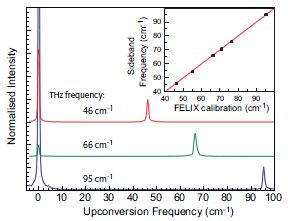
We have quantified the sensitivity of a simple method to measure the frequency spectrum of pulsed terahertz (THz) radiation. The THz pulses are upconverted to the optical regime by sideband generation in a zinc telluride (ZnTe) crystal using a continuous wave (cw) narrow-bandwidth near-infrared laser. A single-shot spectral measurement of sideband pulses with a high resolution spectrometer directly provides the spectral information of the THz pulses without the need of adjustable elements in the detection setup.[Opt. Express. 2010]
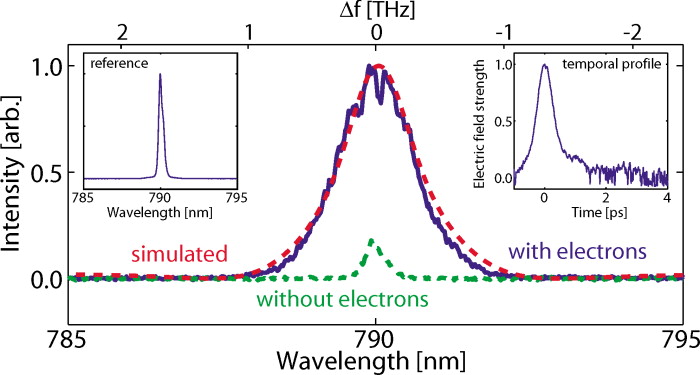
We demonstrate the spectral upconversion of a unipolar subpicosecond terahertz (THz) pulse, where the THz pulse is the Coulomb field of a single relativistic electron bunch. The upconversion to the optical allows remotely located detection of long wavelength and nonpropagating components of the THz spectrum, as required for ultrafast electron bunch diagnostics [Appl. Phys. Lett. 2010]
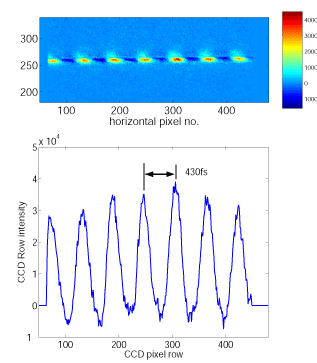
The output from a far-infrared (wavelengths longer than 50 micrometers) free electron laser (FEL) can be characterized with electro-optic detection techniques that are commonly used in THz science. At the FELIX free electron laser we use single-shot detection techniques since the time jitter between the FEL far-infrared pulse and the optical probe pulse is on the order of 400 fs.
Figure right: Single shot electro-optic measurement of a quasi-monochromatic FEL pulse. The wavelength is 130 micrometer, and one cycle therefore corresponds to 430 fs. The image has been obtained by subtracting an image without the presence of an FEL pulse (background) from an image where an FEL pulse was present. The graph has been obtained by vertically binning the image.
More information can be found in our
paper presented at the FEL2004 conference.
Electro-optic detection of the electric field of electron
bunches, which can be regarded as a unipolar THz pulse,
is a promising technique for the measurement of
the bunch length and shape in the sub-picosecond time domain.
The electro-optic detection method makes use of
the fact that the local electric field of a highly relativistic
electron bunch moving in a straight line is almost entirely
concentrated perpendicular to its direction of motion.
This electric field induces birefringence in an electro-optic
crystal placed in the vicinity of the beam. The amount of
birefringence depends on the electric field and is probed
by monitoring the change of polarization of a short optical
laser pulse.
At FELIX we develop schemes for real-time nondestructive, single-shot measurements of the Coulomb field of sub-picosecond electron bunches. More information can be found on the electron bunch webpage.
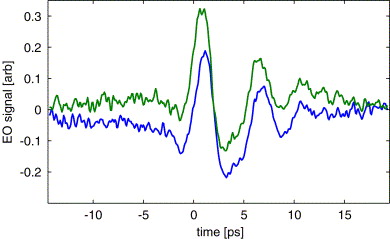
In addition, recent FELIX experiments have used single-shot electro-optic detection to measure the temporal profile of the far-infrared electric field pulse of coherent synchrotron radiation (CSR), initial results of which are reported here. Such time-resolved CSR measurements have the potential for a completely non-invasive bunch longitudinal profile determination, without the ambiguity in profile that is present in CSR spectral measurements. [Berden et al. DIPAC2005, Jamison et al. NIMA 2006]
Figure: The electro-optic signal of the CSR emitted from the entrance to the dipole magnet. Two separate measurements are shown to demonstrate the level of reproducibility.
References
These articles may be downloaded for personal use only. Any other use requires
prior permission of the author and the publisher.
 The output from a far-infrared (wavelengths longer than 50 micrometers) free electron laser (FEL) can be characterized with electro-optic detection techniques that are commonly used in THz science. At the FELIX free electron laser we use single-shot detection techniques since the time jitter between the FEL far-infrared pulse and the optical probe pulse is on the order of 400 fs.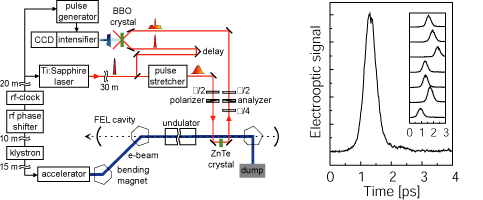
 An ultrawide-bandwidth single-sideband modulator for terahertz frequencies.