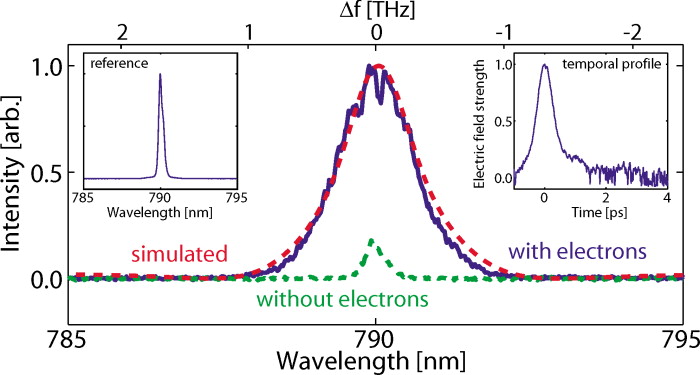
NEW: We demonstrate the spectral upconversion of a unipolar subpicosecond terahertz (THz) pulse, where the THz pulse is the Coulomb field of a single relativistic electron bunch. The upconversion to the optical allows remotely located detection of long wavelength and nonpropagating components of the THz spectrum, as required for ultrafast electron bunch diagnostics [Appl. Phys. Lett. 2010]
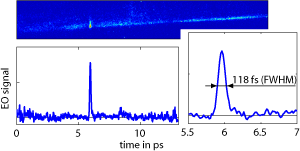
HIGHLIGHT: single-shot electro-optic measurements of the longitudinal profiles of ultra-short relativistic electron bunches at FLASH (DESY, Hamburg) show profiles with a width of 60 fs (rms). Simultaneous measurements with a state-of-the-art transverse deflecting cavity validate the electro-optic detection technique.
[Phys. Rev. Lett. 2007]
Click here to see a movie of the measurements (the changing bunch profiles in the FLASH control system)
Electro-optic detection of the electric field of electron bunches is a promising technique for the measurement of the bunch length and shape in the sub-picosecond time domain. The electro-optic detection method makes use of the fact that the local electric field of a highly relativistic electron bunch moving in a straight line is almost entirely concentrated perpendicular to its direction of motion. This electric field induces birefringence in an electro-optic crystal placed in the vicinity of the beam. The amount of birefringence depends on the electric field and is probed by monitoring the change of polarization of a short optical laser pulse.
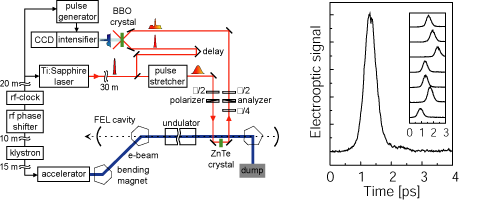
Several electro-optic detection schemes have been proposed and/or demonstrated. The first single-shot measurements have been reported by Wilke et al. [ref] and were carried out at the Free Electron Laser for Infrared eXperiments (FELIX) in Nieuwegein, The Netherlands. In such measurements the temporal profile of the Coulomb field-induced birefringence in the electro-optic crystal is probed by a linearly chirped Ti:sapphire laser, with a pulse length longer than the electron bunch length. This optical probe pulse is passed through a polarizer in order to convert the time dependent phase retardation (birefringence) into an intensity modulation on the chirped pulse. In this way, the Coulomb field profile is encoded onto the spectrum of the probe pulse through the time-frequency relationship of the probe. The electric field profile of the electron bunch is determined through a single shot measurement of the probe spectrum. Spectral decoding measurements at FELIX show single-shot electric field profiles with a FWHM of 1.7 ps [ref]. The temporal resolution is determined by several factors. The increased duration of the Coulomb field at the probe position, when compared to the electron bunch duration, leads to a temporal resolution of 2R/(gamma*c) where R is the radial distance between the electron beam and the optical probe in the electro-optical crystal. For a 50 MeV beam and a distance of 1.5 mm this temporal resolution is 100 fs. The thickness and the material of the crystal contribute to the temporal resolution as well [ref]. For a 0.5 mm ZnTe crystal, electric field Fourier components with a frequency lower than 2.8 THz will be detected with minimal distortions. These two contributions to the temporal resolution are present for all electro-optic detection schemes. For the aforementioned spectral decoding technique there are two other contributions: i) the resolution of the spectrometer and CCD array (300 fs for the single shot measurements reported in Wilke et al.) and ii) the intrinsic coupling between the frequency components of the intensity modulation (induced by the electron bunch) and the frequency components of the chirped optical pulse. This intrinsic time resolution limitation of the spectral decoding technique has been studied in detail [see references in Berden et al.]. For ultra-short electron bunches, the result is that the degree of distortion of the measured electric field profile depends on the actual length of the electron bunch. Therefore it is impossible to make a deconvolution of the measured electric field profile. A way to circumvent the time resolution problems of spectral decoding is to measure the intensity modulated probe pulse in the time-domain [ref]. In this so-called temporal decoding method the chirped pulse carrying the modulation due to the presence of the electron bunch is cross-correlated with a part of the original optical pulse which has been split off before the optical stretching. Single-shot cross-correlation is based on the temporal to spatial conversion that occurs through the spatial overlap of non-collinear beams in a second-harmonic crystal. Experiments at FELIX show single-shot profiles with a FWHM of about 650 fs [ref].
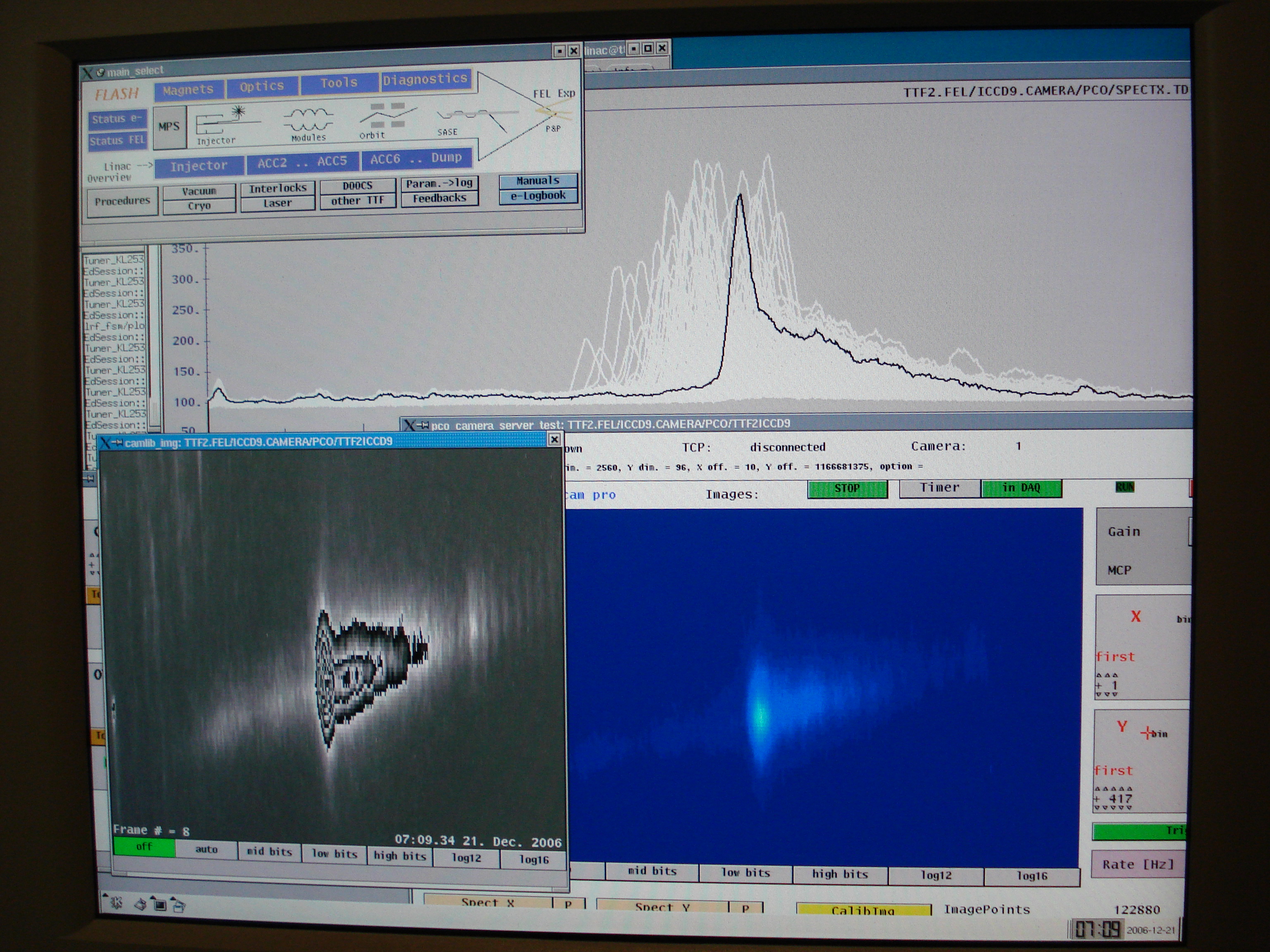
Photograph of a computer screen showing the software of electro-optic diagnostics at FLASH. High resolution photo available by clicking on the small photo. Click here to see a movie of the measurements (the changing bunch profiles in the FLASH control system). Measurements were carried out during FEL user operation of FLASH at a beam energy of 450 MeV. The measurements are non-destructive and do not disturb the quality of the soft-x-ray FEL beam. The black trace on a grey background, shows the last single-shot electron bunch profile. The white traces show the previous measurements. The leading edge of the bunch is on the left. Photograph and video by Giel Berden (copyright: Berden / Jamison / Phillips / Steffen).
 Shorter electron bunches are available at FLASH, the soft x-ray Free electron LASer at Hamburg (DESY, Germany). In the summer of 2005, the electro-optic setup moved to FLASH and was installed at the end of the FLASH accelarator, just before the undulators. The first succesful measurements were performed in October 2005. In 2006, the detection setup was integrated in the control-system of FLASH. A photograph of the computer screen is showed below. For benchmarking the EO detector and determining the performance limitations, we have carried out simultaneous measurements with the electro-optic temporal decoding system and a transverse deflecting rf structure (TDS). In the TDS, the temporal profile of the electron bunch is transferred to a spatial profile on a view screen by a rapidly varying electromagnetic field. The TDS technique is destructive (the electron bunch does not survive the measurement) and the setup is part of the accelerator design (and quite large). The temporal resolution of TDS is, however, very impressive: for our simultaneous measurements it is about 20 fs (rms). Therefore, TDS is ideal for benchmarking the electro-optic detection technique. Results are shown in our paper [Berden et al. 2007].
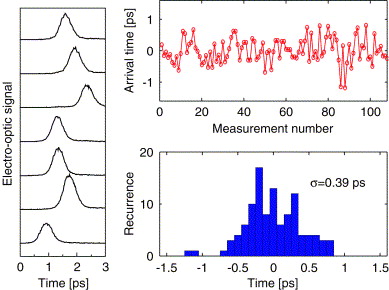 Figure: A series of single-shot temporal decoding measurements of FELIX electron bunches (50 MeV, 250 pC), showing the timing jitter between the laser and electron bunch. The rms timing jitter of is comparable to the bunch length of 275 fs rms (650 fs FWHM).
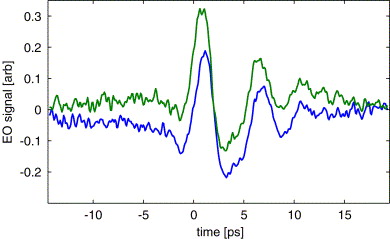
In addition, FELIX experiments have used single-shot electro-optic detection to measure the temporal profile of the far-infrared electric field pulse of coherent synchrotron radiation (CSR), initial results of which are reported here. Such time-resolved CSR measurements have the potential for a completely non-invasive bunch longitudinal profile determination, without the ambiguity in profile that is present in CSR spectral measurements. [Berden et al. DIPAC2005, Jamison et al. NIMA 2006]
Figure: The electro-optic signal of the CSR emitted from the entrance to the dipole magnet. Two separate measurements are shown to demonstrate the level of reproducibility.
These articles may be downloaded for personal use only. Any other use requires prior permission of the author and the publisher.
 Benchmarking of electro-optic monitors for femtosecond electron bunches.
Electro-optic technique with improved time resolution for real-time, nondestructive, single-shot measurements of femtosecond electron bunch profiles.
Single-shot electron-beam bunch length measurements.
Upconversion of a relativistic Coulomb field terahertz pulse to the near infrared.Electro-optic time profile monitors for femtosecond electron bunches at the soft x-ray free-electron laser FLASH.
Electro-optic techniques for temporal profile characterisation of relativistic Coulomb fields and coherent synchrotron radiation.
Limitations of electro-optic measurements of electron bunch longitudinal profile.
Single shot longitudinal bunch profile measurements at FLASH using electro-optic detection techniques.
Single-shot longitudinal bunch profile measurements at FLASH using electro-optic detection: experiment, simulation, and validation.Single shot longitudinal bunch profile measurements by temporally resolved electro-optic detection.
Single shot longitudinal bunch profile measurements at FLASH using electro-optic techniques.
Time resolved single-shot measurements of transition radiation at the THz beamline of FLASH using electro-optic spectral decoding.Temporally-resolved electro-optic effect.
Real-time, single-shot temporal measurements of short electron
bunches, terahertz CSR and FEL radiation.
High temporal resolution, single shot electron bunch-length measurements.
High temporal resolution, single shot electron bunch-length measurements.
Single shot electron-beam bunch length measurements.
Chirped-laser based electron bunch length monitor.
Time-domain terahertz science improves relativistic electron-beam diagnostics.
Real-time single shot electron bunch length measurements.
Benchmarking of electro-optic monitors for femtosecond electron bunches.
Electro-optic technique with improved time resolution for real-time, nondestructive, single-shot measurements of femtosecond electron bunch profiles.
Single-shot electron-beam bunch length measurements.
Upconversion of a relativistic Coulomb field terahertz pulse to the near infrared.Electro-optic time profile monitors for femtosecond electron bunches at the soft x-ray free-electron laser FLASH.
Electro-optic techniques for temporal profile characterisation of relativistic Coulomb fields and coherent synchrotron radiation.
Limitations of electro-optic measurements of electron bunch longitudinal profile.
Single shot longitudinal bunch profile measurements at FLASH using electro-optic detection techniques.
Single-shot longitudinal bunch profile measurements at FLASH using electro-optic detection: experiment, simulation, and validation.Single shot longitudinal bunch profile measurements by temporally resolved electro-optic detection.
Single shot longitudinal bunch profile measurements at FLASH using electro-optic techniques.
Time resolved single-shot measurements of transition radiation at the THz beamline of FLASH using electro-optic spectral decoding.Temporally-resolved electro-optic effect.
Real-time, single-shot temporal measurements of short electron
bunches, terahertz CSR and FEL radiation.
High temporal resolution, single shot electron bunch-length measurements.
High temporal resolution, single shot electron bunch-length measurements.
Single shot electron-beam bunch length measurements.
Chirped-laser based electron bunch length monitor.
Time-domain terahertz science improves relativistic electron-beam diagnostics.
Real-time single shot electron bunch length measurements.
Giel Berden / 2021
Counts since 19/4/2006: