FELIX papers of the Williams group
Papers of the Williams
group (Berkeley) showing the results of several FELIX measurement campaigns:
Coordination of Trivalent Metal Cations to Peptides: Results from IRMPD Spectroscopy and Theory download here Journal of Physical Chemistry A 114 (2010) 854-860.
Isomer Population Analysis of Gaseous Ions From Infrared Multiple Photon Dissociation Kinetics. download here Journal of Physical Chemistry A 115 (2011) 2745-2751.
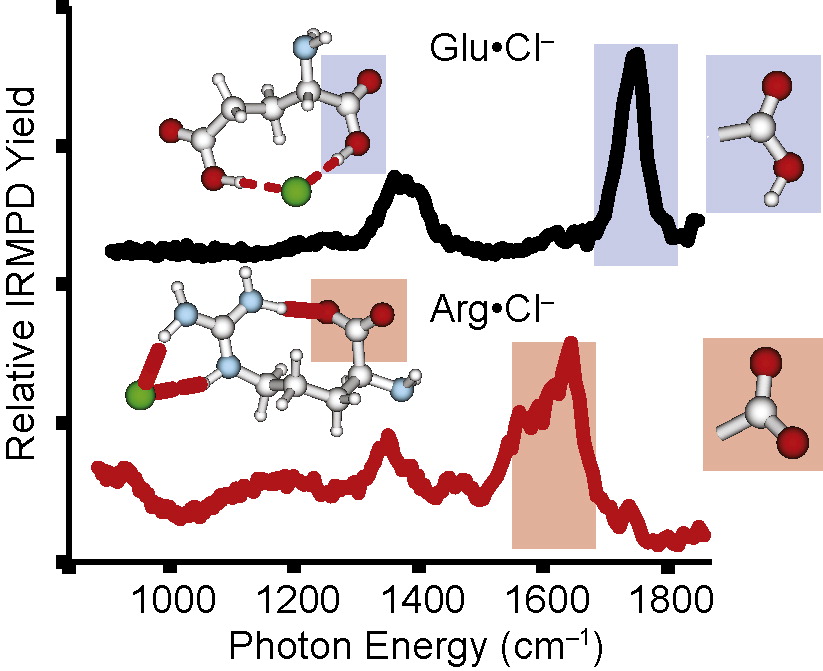
Effects of Anions on the Zwitterion Stability of Glu, His and Arg Investigated by IRMPD Spectroscopy and Theory download here International Journal of Mass Spectrometry 297 (2010) 116-123.
The Ionic Hydrogen/Deuterium Bonds between Diammoniumalkane Dications and Halide Anions. download here ChemPlusChem 78 (2013) 995-1004.
Halide anion binding to Gly3, Ala3 and Leu3. xx (2014) xx-xx. (online first)International Journal of Mass Spectrometry (2014)
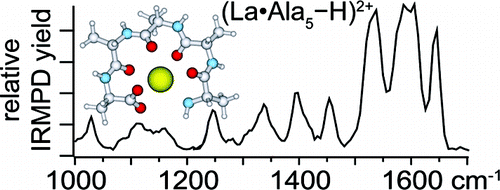 Abstract: Structures of trivalent lanthanide metal cations La3+, Ho3+, and Eu3+ with deprotonated Alan (n = 2-5) or Leu-enk (Tyr-Gly-Gly-Phe-Leu) are investigated with infrared multiple photon dissociation (IRMPD) spectroscopy between 900 and 1850 cm-1 and theory. In all of these complexes, a salt bridge is formed in which the metal cation coordinates to the carboxylate group of the peptide, resulting in a limited conformational space and many sharp IRMPD spectral bands. The IRMPD spectra clearly indicate that all carbonyl groups solvate the metal cation in each of the Alan complexes. Due to strong vibrational coupling between the carbonyl groups, a sharp, high-energy amide I band due to in-phase stretching of all of the amide carbonyl groups bound to the metal cation is observed that is separated by 50 cm-1 from a strong, lower-energy amide I band. This extent of carbonyl coupling, which is sometimes observed in condensed-phase peptide and protein IR spectroscopy, has not been reported in IRMPD spectroscopy studies of other cationized peptide complexes. Intense bands due to carbonyl groups not associated with the metal cation are observed for Leu-enk complexes, indicating that a side chain group, such as the Tyr or Phe aromatic ring, prevents complete carbonyl coordination of the metal cation. Substitution of smaller lanthanide cations for La3+ in these peptide complexes results only in minor structural changes consistent with the change in metal cation size. These are the first IRMPD spectra reported for lanthanide metal cationized peptides, and comparison to previously reported protonated and alkali metal or alkaline earth metal cationized peptide complexes reveals many trends consistent with the higher charge state of the lanthanide cations.
© 2010 American Chemical Society.
Abstract: Structures of trivalent lanthanide metal cations La3+, Ho3+, and Eu3+ with deprotonated Alan (n = 2-5) or Leu-enk (Tyr-Gly-Gly-Phe-Leu) are investigated with infrared multiple photon dissociation (IRMPD) spectroscopy between 900 and 1850 cm-1 and theory. In all of these complexes, a salt bridge is formed in which the metal cation coordinates to the carboxylate group of the peptide, resulting in a limited conformational space and many sharp IRMPD spectral bands. The IRMPD spectra clearly indicate that all carbonyl groups solvate the metal cation in each of the Alan complexes. Due to strong vibrational coupling between the carbonyl groups, a sharp, high-energy amide I band due to in-phase stretching of all of the amide carbonyl groups bound to the metal cation is observed that is separated by 50 cm-1 from a strong, lower-energy amide I band. This extent of carbonyl coupling, which is sometimes observed in condensed-phase peptide and protein IR spectroscopy, has not been reported in IRMPD spectroscopy studies of other cationized peptide complexes. Intense bands due to carbonyl groups not associated with the metal cation are observed for Leu-enk complexes, indicating that a side chain group, such as the Tyr or Phe aromatic ring, prevents complete carbonyl coordination of the metal cation. Substitution of smaller lanthanide cations for La3+ in these peptide complexes results only in minor structural changes consistent with the change in metal cation size. These are the first IRMPD spectra reported for lanthanide metal cationized peptides, and comparison to previously reported protonated and alkali metal or alkaline earth metal cationized peptide complexes reveals many trends consistent with the higher charge state of the lanthanide cations.
© 2010 American Chemical Society.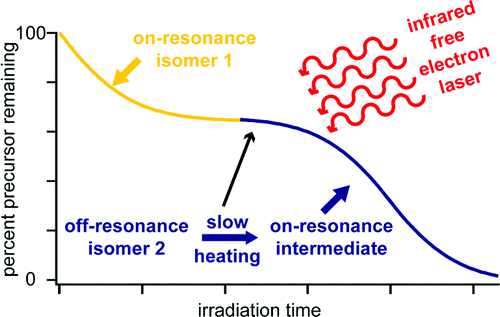 Isomer Population Analysis of Gaseous Ions From Infrared Multiple Photon Dissociation Kinetics.