Time-Resolved Holography with Photoelectrons

Papers of the Vrakking group (AMOLF, but now at the Max Born Institute) showing the results of several FELIX and FELICE measurement campaigns:


Time-Resolved Holography with Photoelectrons.

Y. Huismans, A. Rouzée, A. Gijsbertsen, J.H. Jungmann, A.S. Smolkowska, P.S.W.M. Logman, F. Lépine, C. Cauchy, S. Zamith, T. Marchenko, J.M. Bakker, G. Berden, B. Redlich, A.F.G. van der Meer, H.G. Muller, W. Vermin, K.J. Schafer, M. Spanner, M. Yu. Ivanov, O. Smirnova, D. Bauer, S.V. Popruzhenko, and M.J.J. Vrakking

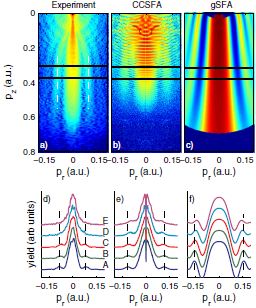
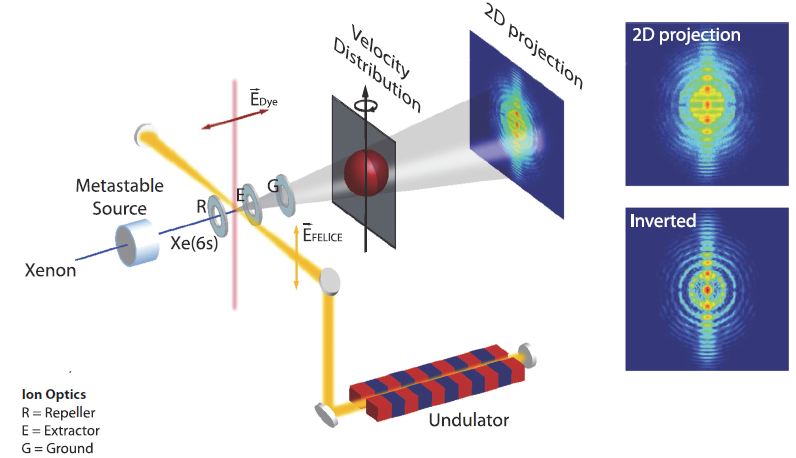
Abstract: Ionization is the dominant response of atoms and molecules to intense laser fields and is at the basis of several important techniques, such as the generation of attosecond pulses that allow to measure electron motion in real time. We present experiments where metastable xenon atoms are ionized by intense 7-micrometer laser pulses from a free electron laser. Holographic structures are observed that record underlying electron dynamics on a sub-laser cycle time scale, enabling photoelectron spectroscopy with a time resolution almost two orders of magnitude higher than the duration of the ionizing pulse. © 2011 Science.
PDF file: download here
Reference: Science 331 (2011) 61-64.


Scaling Laws for Photoelectron Holography in the Midinfrared Wavelength Regime.

Y. Huismans, A. Gijsbertsen, A. S. Smolkowska, J. H. Jungmann, A. Rouzée, P. S. W. M. Logman, F. Lépine, C. Cauchy, S. Zamith, T. Marchenko, J. M. Bakker, G. Berden, B. Redlich, A. F. G. van der Meer, M. Yu. Ivanov, T.-M. Yan, D. Bauer, O. Smirnova, and M. J. J. Vrakking

Abstract: Midinfrared strong-field laser ionization offers the promise of measuring holograms of atoms and molecules, which contain both spatial and temporal information of the ion and the photoelectron with subfemtosecond temporal and angstrom spatial resolution. We report on the scaling of photoelectron holographic interference patterns with the laser pulse duration, wavelength, and intensity. High-resolution holograms for the ionization of metastable xenon atoms by 7–16 µm light from the FELICE free electron laser are presented and compared to semiclassical calculations that provide analytical insight. © 2012 American Physical Society.
PDF file: download here
Reference: Physical Review Letters 109 (2012) 013002.


Photoelectron angular distributions from the ionization of xenon Rydberg states by midinfrared radiation.

Y. Huismans, A. Rouzée, A. Gijsbertsen, P. S. W. M. Logman, F. Lépine, C. Cauchy, S. Zamith, A. S. Stodolna, J. H. Jungmann, J. M. Bakker, G. Berden, B. Redlich, A. F. G. van der Meer, K. J. Schafer, and M.J.J. Vrakking
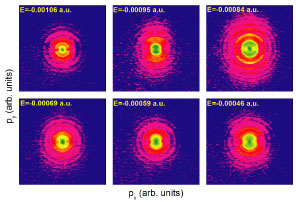
Abstract: Angle-resolved photoelectron spectra, resulting from the strong-field ionization of atoms or molecules, carry a rich amount of information on ionization pathways, electron dynamics, and the target structure. We have investigated angle-resolved photoelectron spectra arising from the nonresonant ionization of xenon Rydberg atoms in the multiphoton regime, using intense midinfrared radiation from a free-electron laser. The experimental data reveal a rich oscillatory structure in the low-order above-threshold ionization region. By performing quantum-mechanical and semiclassical calculations, the observed oscillations could be well reproduced and explained by both a multiphoton absorption picture as by a model invoking electron wave-packet interferences. Furthermore, we demonstrate that the shape and orientation of the initial Rydberg state leaves its own fingerprint on the final angular distribution. © 2013 The American Physical Society.
PDF file: download here
Reference: Physical Review A 87 (2013) 033413.


Above-threshold ionization in a strong dc electric field

Y. Ni, S. Zamith, F. Lépine, T. Martchenko, M. Kling, O. Ghafur, H. G. Muller, G. Berden, F. Robicheaux, and M. J. J. Vrakking

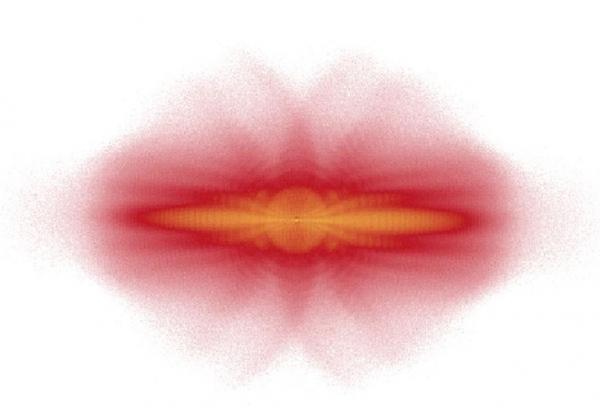
Abstract: High-lying Rydberg states of Xe have been ionized using intense 108 µm radiation from a free-electron laser. Measured two-dimensional photoelectron images reveal significant above-threshold ionization and contain an indirect contribution resulting from the combined action of the atomic Coulomb field, laser field, and dc electric field of the spectrometer on the electron. The observation of indirect ionization contains information about the electron localization directly after the laser excitation and indicates that the experiments are performed in the multiphoton regime of strong-field ionization. The experiments are compared to and interpreted by means of both classical and quantum-mechanical simulations. ©2008 The American Physical Society.
PDF file: Physical Review A 78 (2008) 013413.
Journal: URL Link: http://link.aps.org/abstract/PRA/v78/e013413